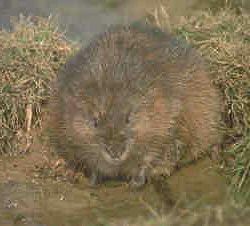
The muskrat is a large, stout, semi-aquatic rodent. Its head is broad and blunt with hidden short ears. The muskrat's coat is practically waterproof and is soft, dense and grayish brown in color. The underfur is covered by brown, protruding guard hairs which serve to protect the soft under hair from wear. Its tail is scaled, nearly hairless, and somewhat flattened on the sides.
This aquatic rodent is found across all of Canada with the exception of the arctic tundra, throughout the United States, and in much of Europe and Asia where it has been introduced by man.
Muskrats live in or near water most of their lives. They make their homes in bank dens or lodges similar to those of the beaver but smaller in size. Muskrats excavate dens by burrowing into the banks of slow-moving streams with their sharp front claws, making entrances underwater. Their houses are constructed of weeds, bulrushes and packed mud, with separate sleeping platforms for each member of the family.
Muskrats are ferocious fighters and have been known to attack humans without provocation. As well as a wide variety of vegetation, they also feed on freshwater mussels and are known to eat frogs and small turtles. Their chief predator is the mink, but while on land they also fall prey to foxes, coyotes, lynx as well as other large predators.
Muskrats are polygamous and breeding takes place from late March through July, after a gestation period of 28 to 30 days. Four litters a year is not uncommon, each with six to seven offspring.
