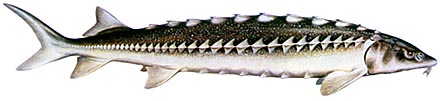
The rough skin of the white sturgeon has no scales, but is covered in rows of protective, bone-like, diamond-shaped plates called scutes. To blend in with their habitat, the predaceous white sturgeon will take on a pigment similar to the waters they spend the most time in. For example, fish from a mud-stained river will usually be a pale grey on top, fading to white on the belly. The sturgeon’s skeleton consists of cartilage except for membrane bones of the skull, jaw, and a girdle surrounding the pectoral fin area.
Spawning female white sturgeon can produce from 700,000 to four million eggs each. Being broadcast spawners, their egg deposition occurs on a wide variety of substrates, ranging from fine and medium-sized gravel to boulders.
There are three strains of white sturgeon stocks:
1) Resident fish that are either landlocked or "do not migrate" to the Pacific Ocean.
2) Anadromous stocks that occasionally travel between fresh and saltwater in search of food.
3) Ocean-going sturgeon that make their way into river systems to feast on other fish.
