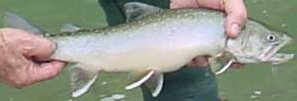
Dolly Varden belong to a group of fish called char, charcterized similarly to the bull trout and eastern brown trout. It has about eight to ten wide, dark parr marks or oval blotches which contrast with the mottled olive-brown color of their body. White Leading Edges are present on anal and pectoral fins.
Sea-run fish are silvery with an olive-green to brown color on the dorsal surface and numerous red to orange spots on their sides. The mature males become brilliant red on the lower body surface and the bottom fins become reddish-black with white along the leading edges. Mature females are similar but are less brightly colored. Dolly Varden can reach 16 to 24 inches, weighing up to 4 pounds. Periodically, 9 to 12 pounders can be found in northern populations.
Anadromous and freshwater resident varieties of both forms exist with lake, river and dwarf populations being found among the freshwater residents. Both residents are primarily piscivorous, eating fish, fish eggs, invertebrates and insects.
Dolly Varden spawn in streams, typically during the fall from mid-August to November. Most Dolly Varden migrate to sea in their third or fourth year, sometimes waiting as long as their sixth year. At this time, they are about 5 inches long and are called smolt. This migration usually occurs in May and June. However, smaller schools have been recorded migrating to sea in September and October.
After a Dolly Varden's first seaward migration, they usually spend the rest of their lives wintering in and migrating to and from fresh water. Dolly Varden from southern regions will overwinter in lakes, while most northern Dolly Varden over winter in rivers. Those hatched and reared in a lake system continue annual feeding migrations to sea, returning to a lake or river each year for the winter.
