The eider is a sea duck found across the arctic and sub arctic zones of the northern hemisphere. There is four species of eiders in the world, all of them breed in Alaska. Some of these birds do not migrate, remaining along coastal waters during winter months. The four species include: Common, king, Steller's and spectacled eiders. Steller's eiders are smaller and one of the most unique and endangered members of the eider family.
The Common Eider (Somateria mollissima) is the largest duck in North America, weighing in at about 6 pound and measuring 24 inches in length. It has a black cap extending to the forehead and around the eye, with a white streak originating from the hind neck. A white throat, chin, neck and cheek extend along the bill. Pacific common eiders are colored with a sharp black line along the jaw forming a "V" pointing toward its yellow to orange bill. Its belly, rear, sides and wings (except for white triangles) are black, while the chest and rear flanks are white.
The common eider is the southernmost breeding eider. It has a nesting range from Sitka in Southeast Alaska along the entire coast into arctic Canada. Small colonies are found in the Kodiak harbor and along Homer Spit. This species of eider nests near clumps of grass or driftwood on along barrier islands. Winter migration takes most common eider to the Bering Sea and the Aleutian Islands.
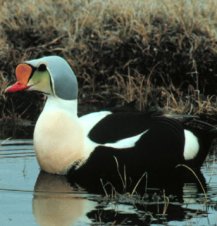
The King eider (Somateria spectabilis) is also a very large duck, measuring in at 24 inches. Males have a distinguishing red bill and large orange frontal lobe extending from the bill up to the forehead. This unique lobe is outlined in black, highlighting a pale blue-gray top half of the head and turquoise shaded cheeks. The king eider has a white chest like the common eider, but is equipped with black a colored back. King eiders have a circumpolar distribution with about 10,000 breeding in Alaska. The center of breeding abundance is in Alaska, along the eastern portion of the Beaufort Sea coast. However, king eiders are in much greater numbers throughout the Canadian arctic islands. Nearly one-half million king eiders migrate through the Beaufort Sea, arriving on breeding areas in early April and May at Point Barrow. Nest sites are scattered along small islets in freshwater tundra ponds of coastal regions.
The Spectacled Eider (Somateria fischeri) and the Steller's Eider (Polysticta stelleri) are both a non-huntable and protected species of eider. Spectacled eiders have a very unique pale green head; while the Steller's eider is small (2 lbs.) and unusually colorful for a sea duck.
