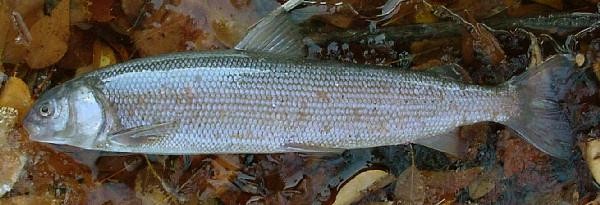
The mountain whitefish is also known as a Rocky Mountain
whitefish, can grow to be 28 inches in length. It is a member of the trout family
(Salmonidae) and is equipped with large scales, a small head and very small overhung toothless mouth. Mountain whitefish are charcoal above, colored with somewhat silvery, dull brown or olive sides. All fins have black tips, a triangular dorsal fin, a big adipose fin with a forked tail fin.
They are native to western North America from northern Utah, Wyoming and western Montana, north into the Saskatchewan River drainage in Alberta, and west to the MacKenzie, Liard and Peace River drainages in British Columbia. It is widespread in British Columbia from the Fraser and Columbia River systems, and throughout Pacific coastal drainages of the Bella Coola, Skeena, Nass, and Stikine rivers. In Oregon, Washington, and Idaho it is common throughout the Columbia River system. It also lives along the east slope of the Sierra Nevadas in California.
The mountain whitefish occurs in cold streams, upper levels of lakes and medium to large sized rivers that have deep pools and riffle areas with gravel substrates. Aquatic insect larvae, preferably the larvae of the caddisfly, mayfly, stone fly and midge are major food sources. Ants, mollusks, beetles and other small fishes are also on the menu.
As a fall spawner, mountain whitefish often move into smaller streams where its eggs can be scattered over graveled areas. 1500 to 7000 eggs are released by the female. This bottom feeder can reach ages of up to seventeen and eighteen years of age.
