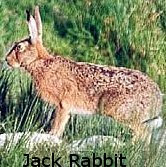
Rabbits are sometimes incorrectly categorized as rodents, but they actually belong to their own order called lagomorphs. Lagomorphs account for 14 wild species in the US, distinguished between "true" rabbits
(Sylvilagus) and hares and jackrabbits
(Lepus).
The eastern cottontail (Sylvilagus floridanus) is the most widely distributed of all "true" wild rabbits. Eastern cottontails have been introduced to the Pacific Northwest, as well as throughout the South and Midwest states. Cottontails are about a foot long when mature, varying in color from gray to brown. They have large hind feet and ears with fluffy cotton like tails. Dense cover and brushy wooded areas are typical environments for a cottontail.
There are three main species of hares (Lepus): black-tailed, white-tailed and the snowshoe hare. Black-tailed and white-tailed hares are commonly called jack rabbits. The snowshoe (varying hare) is known as the snowshoe rabbit.
The black-tailed jack rabbit (Lepus californicus) prefers to live in valleys and flat, open country, while the white-tailed jack lives in more mountainous areas. The two may be distinguished by the color of the underside of their tails. Black-tailed jack's have a brownish underneath, where as the under tail of the white-tailed jack (Lepus townsendii) is white. However, both have very large ears tipped in black.
The snowshoe rabbit (Lepus americanus) is the smallest of the three hares. It looks more like a cottontail rabbit, but its ears are shorter than its head and the underside of its tail is brown, unlike the cottontail's white underside. A snowshoe rabbit will typically prefer to inhabit higher elevations where there is plenty of cover. Because they molt twice a year, the snowshoe blends in excellent with a winter white environment.
The Pygmy Rabbit (Brachylagus idahoensis) is typically colored brown/slate gray with short, white-margined, ears and a small tail. It is the smallest rabbit species in North America, measuring an average between 9 and 11.6 inches in length. Unlike other rabbit species, the pygmy rabbit digs its own burrows in deep, loose soil. A pygmy rabbit's diet consists almost exclusively (98 %) of sagebrush.
Although called a hare, the belgian hare (Oryctologus cuniculus) is in fact a rabbit. The color of the Belgian Hare is a deep, rich, red of a tan or chestnut shade with brilliant black wavy ticking over its back and hips (short fur). Its eyes are large and bold and are surrounded by light circles giving a wild alert expression. Its legs are long, slender, straight and have very fine bones. This rabbit originated in Flanders and was imported to England where it was selectively bred until the present day form was produced. It has been succesfully introduced to America and inhabits the northwest teritories of Canada and Alaska, as well as the lower 48 states.
The actic hare (Lepus othus) is commonly referred to as an Alaskan hare or tundra hare. It is large - 22 to 28 inches in length and 6 to 12 pounds in weight. The winter coat of this large hare is long and the fur is white to the base. Edges of the ears are blackish. In summer the coat is grayish brown above and white below, with a whitish base to the hairs. Its tail is entirely white. The arctic hare populates much of the western coast of Alaska, including the Alaska Peninsula, but has an inconsistant distribution along the Arctic coast and the north slope of the Brooks Range.
Depending on the species, wild rabbits will breed from early Feb. through late Fall, while having three to four litters of 4 or 5 bunnies. Gestation lasts about 28 days. Unlike hares (Lepus), which give birth to young that are born bright eyed and fully haired, the "true" rabbit (Sylvilagus) is born helpless in a shallow depression lined with grass and mother's fur.
