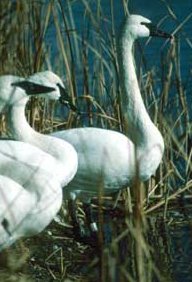
There are two main species of swans that are available in some states for harvesting.
The Trumpeter Swan (Cygnus buccinator) is the largest waterfowl in North America. The adult trumpeter swan is entirely white, although the head and neck are sometimes stained an orange color due to iron-rich waters and mud where they forage for food. They can reach 5 feet in length, have a wingspan up to seven feet and weigh over 20 pounds. Both sexes are similar in appearance, with males being slightly larger. The webbed feet and legs are black, as well as its straight bill. The lower mandible can be have a red line along the upper edge. Some trumpeter swans have become year round residents (non-migratory). However, a Canadian subpopulation breeds in parts of British Columbia, Alberta, the Yukon, and the Northwest Territories, moving south in late October to early November
The Tundra Swan (Cygnus columbianus) is similar to the trumpeter swan, although smaller. Tundra swans have a curved culmen, the bill has a yellow spot, the eye is enclosed by black and the white feathering on the head extends in a V shape into the dark bill. The adult Mute Swan (Cygnus olor) is similar to the tundra, except it has an orange and black knobby bill.
Migration for these non-resident swans is similar, including nesting habits. Nesting begins in late April or early May in the inter mountain western U.S., with clutch sizes of 2 to 9, (averaging about 5). In Yellowstone National Park and environs, clutch size is about four. Incubation, mostly conducted by the female, lasts 33 to 37 days. Offspring hatch during June in the inter mountain western U.S.
