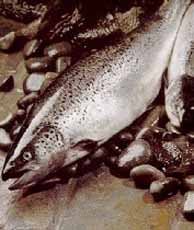
Atlantic salmon have silvery to yellowish brown sides with dark spots. Atlantics may resemble
Brown Trout, but the tail is slightly forked rather than square, and there are no spots on the adipose fin. Other characteristics include a short jaw that reaches to underneath the eye and an anal fin with 9 to10 rays and a centrally located dorsal fin with a short base.
The Atlantic salmon is referred to as being anadromous because of its habit of migrating from the sea into fresh waters to spawn. Although most Atlantic salmon spend part of their lives at sea there are some which are non-migratory. In several lakes throughout North America, there is a form known as a land-locked salmon (Ouananiche or Sebago).
About 90-95% of all Atlantic salmon die following their first spawning, but some survive to spawn two or three times. The survivors, predominantly female, return to sea to feed between spawning seasons. Spawning normally begins in mid-October and continues through to early January. Lake-run adults enter their parent streams to spawn, and each river or stream has a characteristic time when this happens.
